Undergraduate
Duration 4 Years


B.Tech ECE Specializing in Semiconductor Design is a newly created undergraduate course that addresses the growing requirements of the semiconductor business and microelectronics. It integrates the ideas of electronics and communications with knowledge in design, fabrication, and testing of semiconductor devices and systems.
This specialization is for gaining expertise in fields like Very-Large-Scale Integration (VLSI), nanoelectronics, chip design, fabrication processes, and electronic system-level design automation. This program supports India's Atmanirbhar Bharat policy and the worldwide shortage of semiconductors and has good career prospects both in the national and global markets.
Specializations Offered
Duration: 4 yrs. (8 Semesters)
Manav Rachna offers a unique educational experience that combines academic excellence, practical exposure, and industry partnerships to equip students with the skills needed for real-world success.
Alumni Imprints Globally
Published Research Papers
MNC's & Indian Corporate Recruit
Patents (Filed/Granted)
Global Academic Collaborations
Alumni & In-Campus Startups
Countries with Footprints
Highest CTC Offered
Minimum Eligibility Criteria
Pass 10+2 examination with a minimum of 55% marks in aggregate in the 5 below mentioned subjects:
*Note A: Chemistry / Computer Science/Electronics/Information Technology/Biology/Informatics Practices/Biotechnology/ Technical Vocational subject / Agriculture / Engineering Graphics / Business Studies / Entrepreneurship
Admission Criteria
Merit preparation and shortlisting of candidates will be based on XII Qualifying Examination marks, SAT, MRNAT, or JEE Mains.
Nationality
Home students of India and foreign students are eligible to apply.
Scholarship Programme - Utkarsh and Uttam
Merit scholarships for 100% fee waiver for merit achievers.
Industry-Specific Curriculum
Specific VLSI courses, CMOS design, device modeling, IC fabrication, and semiconductor physics.
Hands-On Learning with High-End Labs
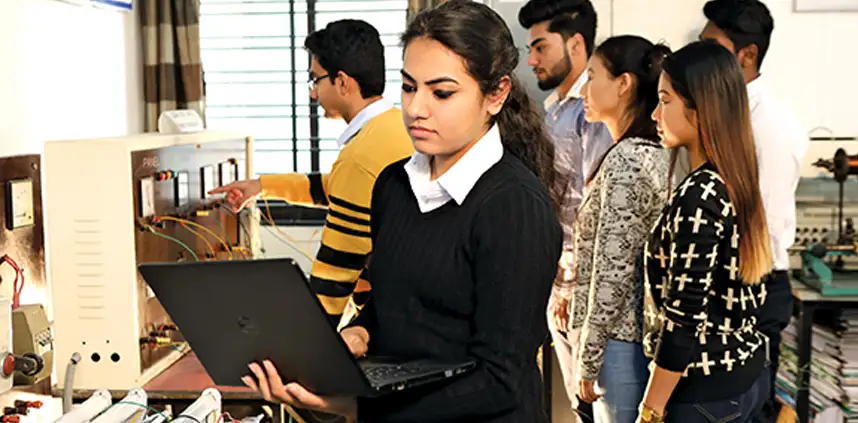
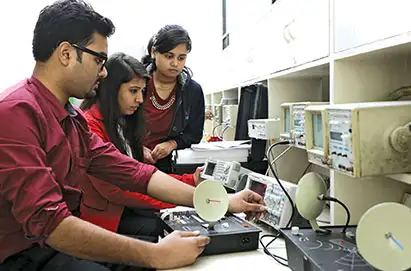
Area for the most advanced labs for VLSI design, microelectronics, fabrication, and cleanroom process.
Association with Industry Leaders
Industry leadership collaboration and internship with industry giants such as Intel, TSMC, STMicroelectronics, and Texas Instruments.
Chip Design Tools & Software Focus
Teaching of the industry's best EDA tools such as Cadence, Synopsys, Mentor Graphics, and Xilinx Vivado.
Research-Oriented Approach
Freedom to work on subsidized semiconductor research projects and publish in conferences and journals.
Capstone Projects & Start-up Support
Year-long SoC design, ASIC/FPGA implementation, or fabrication-based projects with incubation support for entrepreneurial projects.
Fabrication & Testing Integrated Exposure
Hands-on exposure in lithography, doping, etching, packaging, and testing processes.
Semiconductor Domain Expertise Faculty
Classroom lectures by experienced faculty members with PhDs and industry backgrounds in semiconductor engineering.
Placement & Career Opportunities
Excellent placement record in semiconductor companies, EDA companies, defense R&D laboratories, and high-technology streams of education (MS/PhD).
Global Opportunities & Higher Education
Excellent foundation for graduate research in microelectronics, nanotechnology, and device physics in the universities of global excellence.
Internships with Semiconductor Companies
Opportunity in top companies such as Intel, AMD, Qualcomm, Texas Instruments, STMicroelectronics, NXP, and MediaTek, familiarizing students with real VLSI, chip design, testing, and fabrication.
Industrial Training Programs
Short training is conducted with design houses or fabrication labs and training centers for practical work using software like Cadence, Synopsys, Mentor Graphics, and Xilinx.
Industry-Sponsored Projects
Final-year or capstone project is undertaken in conjunction with actual semiconductor or EDA companies to solve real-world problems and are mentored by industry experts. Students have participated in theoretical workshops on RTL design, ASIC/FPGA implementation, or semiconductor physics presented by industry experts.
Industry Visits / Tours of Fabrication Labs
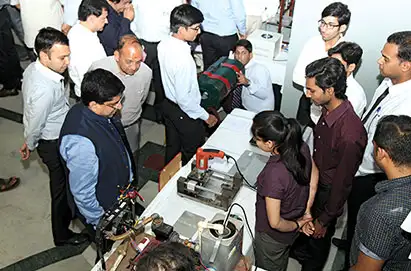
Students are taken to view the wafer fabrication process, cleanroom, and backend packaging through tours of a fabrication or research and development semiconductor centre.
Guest lectures / seminars from industry experts
Students are exposed to guest lectures by industry experts covering current trends in SoC design, AI chips, and low-power electronics, and in general career counselling and networking.
Hackathons, Design Competitions
Design competitions at local, national, and international levels, e.g., Cadence Design Contest and Intel FPGA Innovation Challenge offer students the opportunity for innovative circuit and system-level design creativity.
Industry-Led Curriculum / Co-teaching Modules
Created in partnership, or co-taught by industry professionals, the teaching package is continuously updated to reflect recent industrial needs.
Partnering with Semiconductor Startups / Incubators
Students gain experience prototyping, developing products and innovating in a startup environment with the possibility of IoT, wearables technology, or embedded chip solutions.
Professional Certification Programs
Industry tested certification through Coursera, etc.
Internship
Industry-specific Internships: Internships give you exposure to real industry experience working with companies like Intel, Samsung Semiconductor, Qualcomm, Texas Instruments, NXP, and Cadence Design Systems.
Campus Internships: Work with faculty on short or longer term projects that deal with real world projects in VLSI, FPGA, MEMS, and embedded systems.
Government funded (Internships/Research opportunities): Summer internships and sponsored research project opportunities with ISRO, DRDO, MeitY and CDAC on chip design and nanoelectronics work.
Placement
Major recruiters: Intel, MediaTek, AMD, Synopsys, STMicroelectronics, Micron, TSMC India, and HCL Technologies.
Positions offered: VLSI design engineer, SoC verification engineer, Analog layout engineer, embedded systems developer and FPGA design engineer.
Placement readiness: Training was conducted in the following: Digital IC design, Analog IC design, Verilog, System Verilog, SPICE Model simulations tools and electronic design automation (EDA) tools from Cadence, Synopsys and Mentor Graphics.
Top Recruiters
At the forefront of India’s semiconductor mission, the B.Tech. in Electronics and Communication Engineering with a specialization in Semiconductor Design opens doors to cutting-edge career paths. The program is designed in collaboration with industry leaders to ensure graduates are prepared for the evolving needs of the semiconductor and EDA sectors.
Top Recruiting Sectors
Semiconductor Industry:
Capstone Project & Research
The Electronics and Communication Engineering (ECE) program at Manav Rachna integrates skill based events and workshops (e.g., LAM Semulator, Synopsys, Cadence software tools) to make sure that students leave the class room with a practical, hands-on experience. This practical learning experience enhances the experiential problem-based learning, the bridging of knowledge from theory to real-world thinking, as well as the aspects of innovation, understanding of technology, and problem-solving capabilities.
Capstone Projects require students to confront problems based on industry focused problems, and new and emerging technologies. Projects cover areas such as:
Faculty and students are engaged in research in the following thrust areas:
Innovation & Startups
Innovation and Startups are facilitated by the Manav Rachna Business Incubator, providing facilities, including;
Alumni Network
Alumni network, professionals working at organizations like Intel, Google, ISRO and creators/ artist like choreography and movie even!
It is a complete ecosystem in learning by doing, research, global exposure and access to support that equips ECE graduates at Manav Rachna University to pursue a diverse career path that has an impact in the world.
Global Exposure
Global Exposure occurs in limitless ways, including opportunities for global certifications, higher education and specialized training that every student can find a way to develop their career path globally.
Student Achievements
Student Achievements in Electronics and Communication Engineering (ECE):
Industry Placements and Internships:
Competitive Exam Success:
Technical Event Awards at Innoskill 2025:
These achievements reflect the program’s strong industry orientation, emphasis on innovation, and student excellence in both technical and competitive domains.
Why Pursue ?
Electronics and Communication Engineering (ECE) is a branch of engineering that enables a vast number of opportunities due to being high-tech and having different cross-disciplinary applications across multiple high-growth sectors.
Faculty of ECE graduates may work in the electronics sector- in areas like chip design, embedded systems, and consumer electronics- as a design-in engineer on the development of advanced microchips and smart devices that collect and process information. The telecom sector is another area for ECE graduates that will consistently need skilled workers, as ECE graduates develop and maintain mobile networks, satellite communication systems, or internet infrastructure to facilitate wired and wireless devices. New surrounding technologies- like 5G and IoT- drive the demand for ECE graduates.
There are a diverse number of reasons that make ECE graduates attractive to other sectors, especially IT and software. There are many ECE graduates that become software developers, network engineers, or work in cloud support. Major IT companies are frequently hiring ECE graduates for their engineering, programming, and mathematical skills.
There are huge opportunities for the core PSUs at ISRO, DRDO, BEL, BSNL, etc., where graduates can work on national projects in defence, space, and communications. Also, skills in ECE have value in other industries such as automotive, aerospace, healthcare, medical devices, and energy and power; The agility of ECE is remarkable.
In case people are interested in pursuing higher studies, ECE provides a good platform to branch off into specific postgraduate multi-disciplinary programs, such as an M.Tech or MS programs related to, VLSI, robotics, signal processing, wireless communication, embedded systems, etc. It is also possible for graduates to pursue an MBA degree to become tech-managers and utilize both tech and management skills. Finally, research careers in India and abroad are quite plentiful and could help get them into academia or have opportunities to build cutting-edge products in the industry.
ECE is a multidimensional and evergreen discipline that allows graduates to follow any of a variety of technical, managerial, or research avenues. It places you at the cutting edge of innovation in such areas as AI, IoT, Robotics, and communication systems with skills that are applicable globally and are in high demand.
Course Fee (Annual): INR 2,20,300 US $ 3300
Duration: 4 Years
Modes of Payment
We at Manav Rachna offer generous residential facilities and convenient transportation services so that each student, including those studying Manav Rachna, gets to enjoy a safe, comfortable, and fulfilling campus life.
MREI provides on-campus and off-campus hostel facilities for boys and girls with various types of rooms. Students can choose single, double, and triple rooms as per their preference.
Key Points
Room Types: The hostels offer different types of rooms to suit different budgets and preferences:
Fee Structure: The hostel fee is to be paid on the basis of the room category chosen by the student and it can be paid through DD (Demand Draft) or in cash.
Additional Facilities:
At Manav Rachna, we offer world-class sports facilities to keep our students fit and active. Our facilities comprise a range of outdoor and indoor games, including:
Mess plan also comes as part of hostel fee. Healthy food is served through the mess considering the multicultural requirements of different food habits for the students. By providing choices involving vegetarian as well as non-vegetarian options, healthy lifestyle is available for the students enabling them to pursue their studies focusing on programs with full seriousness.
Notable facilities include:
The facilities enable students to pursue physical exercises that complement their academic development.
Laundry facilities are available at an extra fee in the hostel fees. This saves students from worrying about laundry, so they can focus on their studies, and also allows their clothes to remain properly cleaned.
There is a vast parking space facility available for students who commute using their own means of transport. It is provided to cater to the requirements of students, so that their travel will be easy and hassle-free.
Our well-maintained transport facility offers a stress-free, secure, and safe journey for students from Delhi and Gurugram. The GPS-located, contemporary fleet of buses is operated by professionally trained personnel, with onboard support staff to assist students. Our emphasis is on reliability, safety, and convenience, ensuring unproblematic travel to and from the campus.
Manav Rachna offers a unique educational experience that combines academic excellence, practical exposure, and industry partnerships to equip students with the skills needed for real-world success.
Log in to www.manavrachna.edu.in and click on the Admissions link.
Click on "Apply Now," generate your login credentials, and fill out the form with your personal, educational, and contact information.
Fill in the application by paying online using net banking, debit/credit card, or UPI.
Get qualified through MRNAT (Manav Rachna National Aptitude Test) or produce a valid JEE Main score for merit-based admission.
Program Outcomes (PO's)
Engineering knowledge
Apply the knowledge of mathematics, science, engineering fundamentals, and an engineering specialization to the solution of complex engineering problems.
Problem Analysis
Identify, formulate, review research literature, and analyze complex engineering problems reaching substantiated conclusions using first principles of mathematics, natural sciences, and engineering sciences.
Design/Development of Solutions
Design solutions for complex engineering problems and design system components or processes that meet the specified needs with appropriate consideration for the public health and safety, and the cultural, societal, and environmental considerations.
Conduct Investigations of Complex Problems
Use research-based knowledge and research methods including design of experiments, analysis and interpretation of data, and synthesis of the information to provide valid conclusions.
Modern Tool Usage
Create, select, and apply appropriate techniques, resources, and modern engineering and IT tools including prediction and modeling to complex engineering activities with an understanding of the limitations.
The Engineer and Society
Apply reasoning informed by the contextual knowledge to assess societal, health, safety, legal and cultural issues and the consequent responsibilities relevant to the professional engineering practice.
Environment and Sustainability
Understand the impact of the professional engineering solutions in societal and environmental contexts, and demonstrate the knowledge of, and need for sustainable development.
Ethics
Apply ethical principles and commit to professional ethics and responsibilities and norms of the engineering practice.
Individual and Team Work
Function effectively as an individual, and as a member or leader in diverse teams, and in multidisciplinary settings.
Communication
Communicate effectively on complex engineering activities with the engineering community and with society at large, such as, being able to comprehend and write effective reports and design documentation, make effective presentations, and give and receive clear instructions.
Project Management and Finance
Demonstrate knowledge and understanding of the engineering and management principles and apply these to one’s own work, as a member and leader in a team, to manage projects and in multidisciplinary environments.
Life-long Learning
Recognize the need for and have the preparation and ability to engage in independent and life-long learning in the broadest context of technological change.
Program Specific Outcomes (PSO's)
Connect learning from Core and Disciplinary/Interdisciplinary elective courses of Electronics and Communication Engineering to assimilate technological advancements in the field for analyzing and designing subsystem processes to arrive at the solution to real world problems.
Acquire hardware and software skills pertinent to research and industry practices in the field of Electronics & Communications while acquiring soft skills like persistence, proper judgment through projects and industrial interactions.
Ability to identify indigenous processes and components for producing high quality, compact, energy efficient and eco-friendly solutions at affordable prices for existing and new applications directly and indirectly related to the Electronics & Communication industry
Focus on acquiring right blend of aptitude and attitude so as to be the candidate of first choice for placements and higher education or to become a successful Entrepreneur and a worthy global citizen.