Undergraduate
Duration 3 Years


The Department of Civil Engineering at SET, Manav Rachna International Institute of Research and Studies, was established in 2009 with a strong focus on sustainability and innovation. It offers a B.Tech in Civil Engineering designed to prepare students for the evolving challenges of the construction and infrastructure industry. The program integrates fundamental engineering principles, hands-on laboratory training, and industry-relevant skills, incorporating innovation through research, smart technologies, and sustainable design approaches. This ensures that graduates are equipped to meet global demands and drive advancements in civil engineering.
For B.Tech (Civil Engineering, Lateral Entry with specialization), students must earn 127 credits to be awarded the degree with honors.
Specializations Offered
Duration: 3 yrs. (6 Semesters)
Academic flexibility is embedded in the curriculum, with 42 out of 160 credits or 62 out of 180 credits available for discipline electives, interdisciplinary electives, and open elective courses.
Industry-ready students are developed through industrial training after the 2nd semester (2 weeks, 1 credit), 4th semester (4-6 weeks, 2 credits), 6th semester (4-6 weeks, 2 credits), and in the 8th semester (minimum 20 weeks, 10 credits).
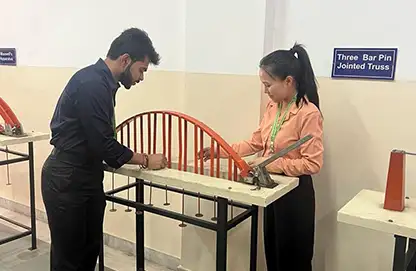
Hands-on experience is provided through 15 core laboratory courses along with integrated laboratory courses in core/discipline electives, totaling 16 credits.
The curriculum includes contemporary civil engineering software such as AutoCAD, STAAD Pro, ETABS, MS Project, Primavera, and QGIS.
“Design Thinking and Innovation” sequence courses are offered from the 3rd to 5th semester (4 credits), including plagiarism checks, feasibility checks for startups, and compilation/documentation of outcomes such as research papers, patents, products, startups, or copyrights.
Project Phase I (1 credit) and Project Phase II (4 credits) are conducted in the 6th and 7th semesters, focusing on qualitative and quantitative research outcomes.
Courses on computer proficiency and programming skills are included (6 credits).
QAPD is offered from the 1st semester onwards, and foreign language courses are available in the 5th and 6th semesters (4 credits).
Manav Rachna offers a unique educational experience that combines academic excellence, practical exposure, and industry partnerships to equip students with the skills needed for real-world success.
Alumni Imprints Globally
Published Research Papers
MNC's & Indian Corporate Recruit
Patents (Filed/Granted)
Global Academic Collaborations
Alumni & In-Campus Startups
Countries with Footprints
Highest CTC Offered
Candidates seeking lateral entry to the B.Tech (Civil Engineering) program must have either:
A 3-year Diploma in Engineering (any branch) from a State Board of Technical Education or an equivalent institution, or
A B.Sc. degree from a recognized university, with a minimum of 50% marks in aggregate.
General Eligibility
Lateral Entry
Candidates must have passed a 3-year Diploma in Engineering in any branch/discipline from a State Board of Technical Education or equivalent, or a B.Sc. degree from a recognized university, with at least 50% marks and Mathematics as a subject in 10+2.
Nationality
Kindly contact the Office of International Admissions, MRIIRS.
Selection Criteria
Kindly contact the Office of International Admissions, MRIIRS.
Scholarship Programme - Utkarsh and Uttam
Kindly contact the Office of International Admissions, MRIIRS.
Academic flexibility embedded in the curriculum: 62 out of 147 credits for discipline electives, interdisciplinary electives, and open elective courses.
Industry-ready students with industrial training after 2nd semester (2 weeks: 1 credit); 4th semester (4-6 weeks: 2 credits); 6th semester (4-6 weeks: 2 credits); and in 8th semester (minimum 20 weeks: 10 credits).
Hands-on experience through curriculum: 15 core laboratory courses along with integrated laboratory courses in core/discipline electives, totaling 16 credits.
Contemporary civil engineering software like AutoCAD, STAAD Pro, ETABS, MS Project, Primavera, and QGIS included in the curriculum.
“Design Thinking and Innovation” sequence courses from 3rd semester to 5th semester (4 credits) with plagiarism check, feasibility check for startups, and compilation/documentation of outcomes such as research paper, patent, product, startup, or copyright.
Project Phase I (1 credit) and Project Phase II (4 credits) in 6th and 7th semesters with specified outcomes for qualitative and quantitative research.
Computer proficiency and programming skills-based courses (6 credits).
QAPD from 1st semester onwards and foreign language courses in 5th and 6th semesters (4 credits).
To get a degree in B.Tech Hons. (Civil Engineering with specialization in Smart Infrastructure) – Lateral Entry, a student has to earn additional 18-20 credits.
Students will undergo internships in different odd semesters (III, V, VII) and in the VIII semester (22–24 weeks) in any domain of civil engineering, with options such as:
Placement opportunities are available through absorption from internships, campus placement, or off-campus placement. Internships can be with government agencies, private firms, or research organizations, and may involve work on software tools, design, project management, or fieldwork. Many companies and organizations in Delhi and across India offer structured internships and entry-level positions for civil engineering students, providing practical exposure and a pathway to employment.
Placement Support
Placement support is provided through the CRC (Corporate Resource Centre) and CDC (Career Development Centre) departments. Regular internal mock interviews are organized to boost students’ confidence and readiness for recruitment processes.
Capstone Project & Research
Students actively participate in capstone projects and research in emerging civil engineering domains such as disaster management, sustainable materials and construction practices, and the applications of AI and ML in civil engineering.
Student Support Services
A vertical and horizontal mentor-mentee system is in place to provide comprehensive support to students.
Placement Statistics
For the 2024 batch, 90% of students were placed. Placement records for previous years are available on the official website.
Global Exposure
Students are encouraged to participate in international conferences and seminars to build networks and explore opportunities for internships, projects, placements, and higher education.
Innovation & Startups
The Manav Rachna Business Incubator nurtures the innovative instincts of students, alumni, and faculty. It provides access to design, fabrication, and manufacturing facilities, mentorship, expertise, and networking, along with pathways to capital from investors and government bodies. The incubator offers integrated innovation-based incubation support, regulatory and financial guidance, and capacity-building programs, ensuring robust support for research and entrepreneurship.
Placement Outcomes
The placement record at Manav Rachna International Institute of Research and Studies demonstrates strong industry connections, with students placed in leading organizations such as TCS, IBM, Tata Steel, EY, and HDFC Bank. The median salary for BTech graduates in 2023 was ₹5.75 lakh, and the highest package reached ₹22 lakh. The CRC plays a pivotal role in organizing placement drives, career counseling, and connecting students with potential employers. Internship opportunities are also provided to help students gain practical experience and enhance employability. Over 500 recruiters participated in recent placement sessions, offering diverse roles across sectors.
Industry Exposure
At MRIIRS, the Department of Civil Engineering bridges classroom learning with real-world industry exposure through various initiatives:
Course Fee (Annual): INR 2,00,500 US $ 4000
Duration: 3 Years
Modes of Payment
We at Manav Rachna offer generous residential facilities and convenient transportation services so that each student, including those studying Manav Rachna, gets to enjoy a safe, comfortable, and fulfilling campus life.
MREI provides on-campus and off-campus hostel facilities for boys and girls with various types of rooms. Students can choose single, double, and triple rooms as per their preference.
Key Points
Room Types: The hostels offer different types of rooms to suit different budgets and preferences:
Fee Structure: The hostel fee is to be paid on the basis of the room category chosen by the student and it can be paid through DD (Demand Draft) or in cash.
Additional Facilities:
At Manav Rachna, we offer world-class sports facilities to keep our students fit and active. Our facilities comprise a range of outdoor and indoor games, including:
Mess plan also comes as part of hostel fee. Healthy food is served through the mess considering the multicultural requirements of different food habits for the students. By providing choices involving vegetarian as well as non-vegetarian options, healthy lifestyle is available for the students enabling them to pursue their studies focusing on programs with full seriousness.
Notable facilities include:
The facilities enable students to pursue physical exercises that complement their academic development.
Laundry facilities are available at an extra fee in the hostel fees. This saves students from worrying about laundry, so they can focus on their studies, and also allows their clothes to remain properly cleaned.
There is a vast parking space facility available for students who commute using their own means of transport. It is provided to cater to the requirements of students, so that their travel will be easy and hassle-free.
Our well-maintained transport facility offers a stress-free, secure, and safe journey for students from Delhi and Gurugram. The GPS-located, contemporary fleet of buses is operated by professionally trained personnel, with onboard support staff to assist students. Our emphasis is on reliability, safety, and convenience, ensuring unproblematic travel to and from the campus.
Manav Rachna offers a unique educational experience that combines academic excellence, practical exposure, and industry partnerships to equip students with the skills needed for real-world success.
Log in to www.manavrachna.edu.in and click on the Admissions link.
Click on "Apply Now," generate your login credentials, and fill out the form with your personal, educational, and contact information.
Fill in the application by paying online using net banking, debit/credit card, or UPI.
Get qualified through MRNAT (Manav Rachna National Aptitude Test) or produce a valid JEE Main score for merit-based admission.
Program Outcomes (PO's)
Engineering knowledge
Apply the knowledge of mathematics, science, engineering fundamentals, and Engineering specialization to the solution of complex engineering problems.
Problem Analysis
Identify, formulate, research literature, and analyse engineering problems to arrive at substantiated conclusions using first principles of mathematics, natural, and engineering sciences.
Design/Development of Solutions
Design solutions for complex engineering problems and design system components, processes to meet the specifications with consideration for the public health and safety, and the cultural, societal, and environmental considerations.
Conduct Investigations of Complex Problems
Use research-based knowledge including design of experiments, analysis and interpretation of data, and synthesis of the information to provide valid conclusions.
Modern Tool Usage
Create, select, and apply appropriate techniques, resources, and modern engineering and IT tools including prediction and modelling to complex engineering activities with an understanding of the limitations.
The Engineer and Society
Apply reasoning informed by the contextual knowledge to assess societal, health, safety, legal and cultural issues and the consequent responsibilities relevant to the professional engineering practice.
Environment and Sustainability
Understand the impact of the professional engineering solutions in societal and environmental contexts, and demonstrate the knowledge of, and need for sustainable development.
Ethics
Apply ethical principles and commit to professional ethics and responsibilities and norms of the engineering practice.
Individual and Team Work
Function effectively as an individual, and as a member or leader in teams, and in multidisciplinary settings.
Communication
Communicate effectively with the engineering community and with society at large. Be able to comprehend and write effective reports documentation. Make effective presentations, and give and receive clear instructions.
Project Management and Finance
Demonstrate knowledge and understanding of engineering and management principles and apply these to one’s own work, as a member and leader in a team. Manage projects in multidisciplinary environments.
Life-long Learning
Recognize the need for, and have the preparation and ability to engage in independent and life-long learning in the broadest context of technological change.
Program Specific Outcomes (PSO's)
An ability to identify, analyse and design civil engineering problems and use of relevant codal provisions.
An ability to pursue research, higher studies, consultancy and face competitive examinations that offers challenging and rewarding careers in civil engineering.
To prepare learners with a solid foundation in mathematics, sciences, and technical skills needed to analyse and design civil engineering problems.
To prepare learners for meaningful work by applying their strong Civil Engineering business, leadership, and communication skills to meet the expectations of their employers.
To prepare learners to apply knowledge, strong reasoning, and quantitative skills to design and implement creative and sustainable solutions.
To prepare learners to effectively use modern equipments & programming tools to solve real life problems that are technically sound, economically feasible and socially acceptable.
To prepare learners for successful professional career, to excel in higher studies and or to become entrepreneur.
To prepare learners to become ressonsible citizens by serving the community locally, nationally, and internationally.