Undergraduate
4 Years
B.Tech Computer Science and Engineering (CSC)
By clicking, I authorize Manav Rachna to contact me via Email, SMS, WhatsApp, Call, or RCS, overriding DND/NDNC.


B.Tech in Civil Engineering at Manav Rachna International Institute of Research and Studies (MRIIRS) is a vision-centered and holistic undergraduate programme to create quality professionals to design the built environment with technology-based and sustainable practices. SET Department of Civil Engineering, which started in 2009, is dedicated to academic excellence, design orientation, and application of intelligent technologies to infrastructure sectors. The department boasts of training students to solve real issues in the real world by providing a firm understanding of core engineering concepts and real-world learning through state-of-the-art laboratory practices and industry exposure.
The curriculum comprises the traditional pillars of civil engineering such as geotechnical engineering, structural analysis, environmental systems, water resources, and transportation engineering, in addition to newer topics of green building technology, smart infrastructure, and digital forms of project management. The students are provided with sophisticated software such as AutoCAD, STAAD Pro, ETABS, MS Project, and QGIS to design, simulate, and manage projects effectively. This integration of practice and theory sets the graduates ready for the industry and capable of making input in green city planning, smart cities, and resilient public infrastructure.
Programs Offered:
Manav Rachna offers a variety of undergraduate civil engineering programs with differentiated course content to attempt to cater to the scholastic interests and career goals of students from various fields. All these programs have been designed to offer theoretical understanding, practical expertise, and technological proficiency according to the prevailing needs of the industry.
Manav Rachna offers a unique educational experience that combines academic excellence, practical exposure, and industry partnerships to equip students with the skills needed for real-world success.
Alumni Imprints Globally
Published Research Papers
MNC's & Indian Corporate Recruit
Patents (Filed/Granted)
Global Academic Collaborations
Alumni & In-Campus Startups
Countries with Footprints
Highest CTC Offered
B.Tech Civil Engineering Eligibility Criteria
For B.Tech Civil Engineering: Pass 10+2 with minimum 45% aggregate in Mathematics, Chemistry, and Physics from a known board.
For B.Tech Civil Engineering (Lateral Entry): Diploma in Engineering (any discipline) or B.Sc. with minimum 50% from a known university.
Admission Criteria:
Admission through JEE Main or MRNAT (Manav Rachna National Aptitude Test)
Other state-level examinations such as HSTES can be accepted
Nationality
Indian, NRI, PIO, and foreign national students are eligible to apply
Scholarship
Utkarsh and Uttam merit scholarship schemes based on marks in MRNAT 2025
The curriculum is designed with academic flexibility, allowing students to earn 42 out of 160 credits or 62 out of 180 credits through discipline electives, interdisciplinary electives, and open elective courses.
Students become industry-ready through structured industrial training: two weeks after the 2nd semester (1 credit), four to six weeks after the 4th semester (2 credits), another four to six weeks after the 6th semester (2 credits), and a minimum of 20 weeks during the 8th semester (10 credits).
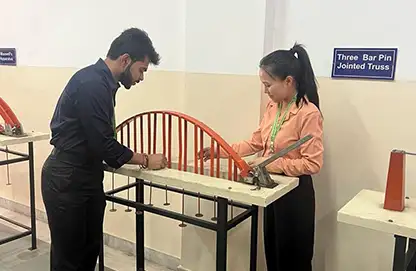
Practical learning is a key focus, with 15 core laboratory courses and integrated laboratory courses in core and discipline electives, adding up to 16 credits.
To meet industry standards, students are trained in widely used civil engineering software, including AutoCAD, STADD Pro, ETABS, MS Project, Primavera, and QGIS.
A dedicated sequence of “Design Thinking and Innovation” courses is offered from the 3rd to the 5th semester (4 credits). These courses encourage creativity, feasibility checks for start-ups, plagiarism-free expression, and documentation of outcomes in the form of research papers, patents, products, or start-ups.
Research orientation is built into the programme with Project Phase I (1 credit) in the 6th semester and Project Phase II (4 credits) in the 7th semester, both focusing on high-quality qualitative and quantitative research.
Computer proficiency and programming skills are developed through specialised courses carrying 6 credits.
From the very first semester, students are introduced to QAPD (Quality Assessment and Professional Development), and they also have the opportunity to learn a foreign language in the 5th and 6th semesters (4 credits).
This programme offers a complete educational experience designed to prepare students for high-impact roles in infrastructure development, consultancy, research, and public sector enterprises. With comprehensive civil engineering subjects from the 1st year onwards, students can build a deep and practical understanding of the discipline, preparing them for success in civil engineering examinations, competitive tests, or higher studies.
Students pursuing this programme are equipped for real-world readiness from the early semesters. Internship and placement support is delivered through:
These initiatives ensure students are prepared not just for employment but for high-impact roles in India's and the world’s EV sector.
Our Top Recruiters
Manav Rachna B.Tech Civil Engineering graduates have been placed in leading national and international organizations in the construction, infrastructure, and consultancy sectors. Our robust industry relations and persistent industry association guarantee students meeting recruiters' expectations.
Our Career Development Centre and Corporate Resource Centre actively facilitates student placement with industry sessions, aptitude training, resume workshops, and mock interviews.
Why Pursue B.Tech in Civil Engineering at Manav Rachna?
Course Fee (Annual): INR 2,00,500 US $ 4000
Duration: 4 Years
Modes of Payment
We at Manav Rachna offer generous residential facilities and convenient transportation services so that each student, including those studying Manav Rachna, gets to enjoy a safe, comfortable, and fulfilling campus life.
MREI provides on-campus and off-campus hostel facilities for boys and girls with various types of rooms. Students can choose single, double, and triple rooms as per their preference.
Key Points
Room Types: The hostels offer different types of rooms to suit different budgets and preferences:
Fee Structure: The hostel fee is to be paid on the basis of the room category chosen by the student and it can be paid through DD (Demand Draft) or in cash.
Additional Facilities:
At Manav Rachna, we offer world-class sports facilities to keep our students fit and active. Our facilities comprise a range of outdoor and indoor games, including:
Mess plan also comes as part of hostel fee. Healthy food is served through the mess considering the multicultural requirements of different food habits for the students. By providing choices involving vegetarian as well as non-vegetarian options, healthy lifestyle is available for the students enabling them to pursue their studies focusing on programs with full seriousness.
Notable facilities include:
The facilities enable students to pursue physical exercises that complement their academic development.
Laundry facilities are available at an extra fee in the hostel fees. This saves students from worrying about laundry, so they can focus on their studies, and also allows their clothes to remain properly cleaned.
There is a vast parking space facility available for students who commute using their own means of transport. It is provided to cater to the requirements of students, so that their travel will be easy and hassle-free.
Our well-maintained transport facility offers a stress-free, secure, and safe journey for students from Delhi and Gurugram. The GPS-located, contemporary fleet of buses is operated by professionally trained personnel, with onboard support staff to assist students. Our emphasis is on reliability, safety, and convenience, ensuring unproblematic travel to and from the campus.
Manav Rachna offers a unique educational experience that combines academic excellence, practical exposure, and industry partnerships to equip students with the skills needed for real-world success.
Log in to www.manavrachna.edu.in and click on the Admissions link.
Click on "Apply Now," generate your login credentials, and fill out the form with your personal, educational, and contact information.
Fill in the application by paying online using net banking, debit/credit card, or UPI.
Get qualified through MRNAT (Manav Rachna National Aptitude Test) or produce a valid JEE Main score for merit-based admission.
Program Outcomes (PO's)
Apply the knowledge of mathematics, science, engineering fundamentals, and Engineering specialization to the solution of complex engineering problems.
Identify, formulate, research literature, and analyse engineering problems to arrive at substantiated conclusions using first principles of mathematics, natural, and engineering sciences.
Design solutions for complex engineering problems and design system components, processes to meet the specifications with consideration for the public health and safety, and the cultural, societal, and environmental considerations.
Use research-based knowledge including design of experiments, analysis and interpretation of data, and synthesis of the information to provide valid conclusions.
Create, select, and apply appropriate techniques, resources, and modern engineering and IT tools including prediction and modelling to complex engineering activities with an understanding of the limitations.
Apply reasoning informed by the contextual knowledge to assess societal, health, safety, legal and cultural issues and the consequent responsibilities relevant to the professional engineering practice.
Understand the impact of the professional engineering solutions in societal and environmental contexts, and demonstrate the knowledge of, and need for sustainable development.
Apply ethical principles and commit to professional ethics and responsibilities and norms of the engineering practice.
Function effectively as an individual, and as a member or leader in teams, and in multidisciplinary settings.
Communicate effectively with the engineering community and with society at large. Be able to comprehend and write effective reports documentation. Make effective presentations, and give and receive clear instructions.
Demonstrate knowledge and understanding of engineering and management principles and apply these to one’s own work, as a member and leader in a team. Manage projects in multidisciplinary environments.
Recognize the need for, and have the preparation and ability to engage in independent and life-long learning in the broadest context of technological change.
Program Specific Outcomes (PSO's)
PSO1:
An ability to identify, analyse and design civil engineering problems and use of relevant codal provisions.
PSO2:
An ability to pursue research, higher studies, consultancy and face competitive examinations that offers challenging and rewarding careers in civil engineering.
BTech Civil Engineering graduates have numerous career opportunities in government and private sectors. Civil engineers form the backbone of infrastructure development and are significantly involved in designing, constructing, and maintaining infrastructure like roads, bridges, buildings, dams, and airports. Following a B Tech degree in Civil Engineering, you may seek careers as:
These posts are available in PSUs like BHEL, NTPC, GAIL, and in foreign infrastructure companies. Some even opt for higher studies or become specialists in transportation, geotechnical, or environmental engineering.
Learning Civil Engineering gives learners technical knowledge that will benefit society through the construction of eco-friendly infrastructure. The major advantages are as follows:
Practical exposure through visits to construction sites, laboratories, and actual projects
Excellent employment prospects for civil engineers in developing and developed nations
A BTech Civil Engineering honors degree offers the satisfaction of designing actual, real projects and the opportunity of high-paying, stable professional jobs.
Remuneration for civil engineers varies by experience, role, location, and employer type. Fresh graduates with a BTech in Civil Engineering receive between ₹3 LPA and ₹5.5 LPA in private organizations, but if they are working with government bodies or PSUs, they will get more along with other allowances.
At 3–5 years of experience, salary can go up to ₹8 LPA and more, especially in metropolitan cities and large infrastructural projects. Specialized roles like structural designing, project handling, and BIM (Building Information Modelling) can also fetch even higher salaries. Earning potential goes up significantly after post-graduation or through certifications like PMP, AutoCAD, STAAD Pro, or Primavera.
Civil Engineering syllabus contains a blend of theoretical concepts and practical technical skills. Foundation engineering subjects that are common to all the streams of B.Tech are studied by the students in the first year, which include:
The Civil Engg syllabus also includes lab experiments, industry projects, and electives pertaining to newer-generation technologies. The students can check the entire BTech Civil Engineering syllabus semester-wise on the official website.
The future of Civil Engineering is evolving with technology and sustainability at its core. Growing need for skilled professionals who can deliver on:
Advanced software competency and cross-disciplinary expertise in AI, IoT, and GIS are also unfolding a larger space for civil engineers. The course curriculum of a B Tech Civil Engg nowadays is designed to prepare students for this thrilling future, and the profession has hence become stable along with innovative. With the infrastructure boom in the world, international opportunities also overflow, especially in the Middle East, Europe, and Southeast Asia.
The highest package offered to a Civil Engineering student from Manav Rachna has gone up to ₹10–12 LPA, depending on how the student performs in academics, internships, and additional certifications. While the average package for Civil Engineering courses after 12th is normally average as compared to some IT streams, students having a strong portfolio, hands-on experience, and industrial exposure have got decent salaries with premier organizations. The placement cell of the university ensures that the students are well-prepared to grab such opportunities.
Yes, Manav Rachna provides scholarship to students applying for Civil Engineering admission based on various parameters such as:
Scholarships can bring down a large amount of Civil Engineering course fees, therefore good education becomes affordable. Students are kindly asked to check scholarship eligibility and apply beforehand to avail these facilities.
To apply for the B.Tech Civil Engineering course at Manav Rachna, do the following:
Visit https://manavrachna.edu.in and check the Civil Engineering programme page.
Admission is provided on MRNAT basis, JEE Main score, or direct admission (merit-based).
Students must check the Civil Engineering eligibility requirements and plan accordingly. Candidates applying early are given preference in scholarships and seat assignments. You can also contact the admissions helpline for customized advice on BTech Civil Engineering charges and course details.
Sector – 43, Aravalli Hills, Delhi – Surajkund Road, Faridabad – 121004, (Haryana), India
For Admission Queries
For Any Other Queries