B.Sc. Food Science and Technology

Programme Overview

B.Sc. Food Science & Technology is a course based on a scientific and research-based approach for understanding, envisaging, and addressing the core of the subject to deal with the emerging technologies related to food. The specific objectives envisioned are in synchronization with PEOs following the core values of customer focus, integrity, innovation, social responsibility and diversity along with a dedication to evidence-based research and practice. The curriculum is aimed at providing updated knowledge, technical skills and research aptitude to students.

The degree programme includes six semesters with courses focusing on employability, entrepreneurship and research skill development. The curriculum offers core, ability enhancement courses and domain specific electives, along with open elective courses each semester. The syllabus covers food science, nutrition, nutritional biochemistry, food processing, preservation, food microbiology, food safety, and food security. A total of 160 credits must be earned: 125 under Compulsory Courses and 35 under Electives.

Duration:  4 yrs. (8 Semesters)

Program Details

The B.Sc. (Hons.) Food Science & Technology program follows the credit-based system with student performance quantified in terms of the number of credits gained upon completing a course successfully. Each course is assigned credits in accordance with the number of lectures, tutorials, or laboratory sessions attended each week. There are compulsorily prescribed courses, labeled as Audit Pass Courses (APC), which bear no credit but must be passed in pursuit of the degree. Earned credits are earned by students passing a marking for each course, which is applied towards the grade point average (GPA). Audit course grades are not included in the GPA but are required in terms of degree requirements.

The program follows the Choice Based Credit System (CBCS). To award a B.Sc. (Hons.) degree in 4 years, the students need to earn 160 credits, of which 125 credits are earned through Compulsory Core Courses and 35 credits are earned through Elective Courses in 8 semesters. For a 3-year B.Sc. degree, the students need to earn 120 credits within 6 semesters, which include 89 credits from Compulsory Courses and 31 credits from Elective Courses. All the subjects within the Compulsory Core need to be cleared by all the students as per semester-wise pattern. The Elective Courses may comprise departmental provided electives and skill development courses, inter-disciplinary or open electives made public by the Dean-Academics, or Massive Open Online Courses (MOOCs) available on platforms like SWAYAM, as recommended by UGC/AICTE.

Students have to register each semester for courses under the compulsory and elective baskets, and any pending courses from previous semesters. But one student cannot register for more than 30 credits in a semester.

According to the National Education Policy (NEP) 2020, there are several options for exit and entry in the undergraduate programme. Students can opt to exit after studying six semesters with a conventional bachelor's degree. After completing the third year, they can opt to pursue a two-year master's programme. Finishing eight semesters results in a Bachelor's Degree with Honours or Honours with Research, the latter involving a research dissertation of a minimum 12 credits in the last year. The Honours with Research degree holders have the option to pursue a one-year Master's programme or even direct entry to a Ph.D. There are also ten-semester integrated master's degree courses, with an exit point after the third or fourth year.

In summary, students are awarded:

  • A three-year undergraduate degree after 120 credits.
  • A four-year undergraduate Honours degree after 160 credits.
  • A four-year undergraduate Honours with Research degree on the achievement of at least 75% marks or 7.5 CGPA in the first six semesters and submission of 12 credits of research, with an overall total of 160 credits.

Key Educational Benefit

Manav Rachna offers a unique educational experience that combines academic excellence, practical exposure, and industry partnerships to equip students with the skills needed for real-world success.

41,000+

Alumni Imprints Globally

2800+

Published Research Papers

600+

MNC's & Indian Corporate Recruit

250+

Patents (Filed/Granted)

120+

Global Academic Collaborations

80+

Alumni & In-Campus Startups

60+

Countries with Footprints

60 LPA

Highest CTC Offered

Eligibility

Pass 10+2 exam or equivalent with at least 50% marks in aggregate in five subjects, of which English, Chemistry, and Biology are compulsory with the best four subjects from the rest.

Admission Criteria

  • Admission will be on the basis of University norms and as per the National Education Policy (NEP) 2020.

Nationality

  • Available to National and International candidates.

Scholarship Programme

Programme Highlights

Experienced Faculty: Renowned for having distinguished teachers with strong educational backgrounds and rich experience in the industrial field.

Industry-Oriented Curriculum: Practical and skill-based learning aimed at employability and job placement.

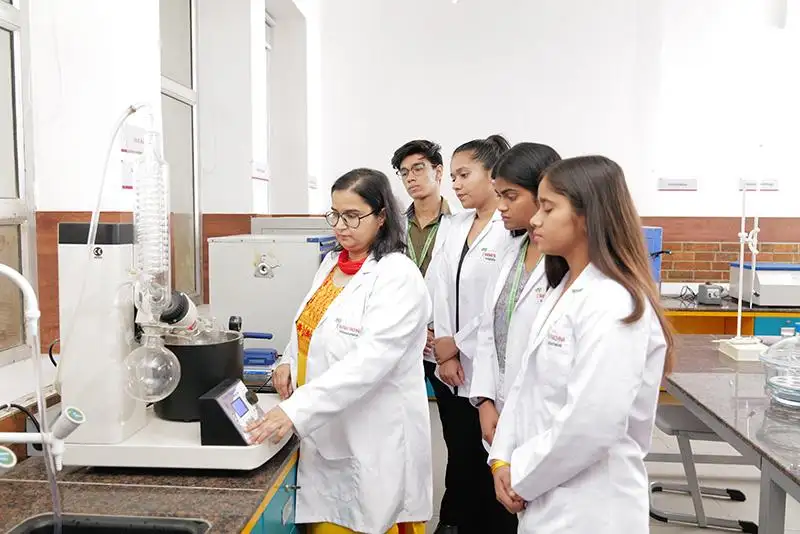
Infrastructure: Food Science and Analytical Laboratories with state-of-the-art instruments.

Interdisciplinary Learning: Courses through NEPTL, SWAYAM, and MOOC platforms for greater academic exposure.

Workshops & Competitions: Ayurveda Day, Texture Analyser Workshop, World Food Day, and hands-on training on Kjeldhal & Soxhlet instruments are amongst a number of events.

Applied Knowledge: Methodical knowledge of food processing, preservation food engineering, and packaging for applications in R & D.

Highly Trained in Food Science: Detailed study of food composition, physico-chemical properties, nutrition, microbiology, and sensory evaluation.

Food Safety & Regulations: Training in the food quality management regime, food safety laws, and regulatory compliance for the food industry.

Holistic Career Development: Preparing students for a wide spectrum of jobs such as Food Technologist, Engineer, Safety Auditor, Analyst, Consultant, Microbiologist, and Entrepreneur.

Industrial Internships: Training in reputed companies such as Amul, Parle, FSSAI, Britannia, Mother Dairy, Nestlé, and Coca-Cola is compulsory.

Research & Innovation: 7 DST-aided startup projects in food waste management and value-added products.

Consultancy project on Edible Packaging with Nutra Supplement Pvt. Ltd., Pune.

The DST project for development of millet-based probiotics.

Collaborations & Partnerships: Active collaborations with KAG Industries, NIFTEM (Kundli), FARE Labs (Gurgaon), and IIMR (Hyderabad).

Short-Term Courses: A 5-day training on Toxicological Aspects of Food Safety, scheduled for June 25–29, 2024, to enhance knowledge in Food Toxicology.

Specialised Training Programmes: Two-week intensive programme on Food Analysis: Biological, Chemical & Instrumentation Techniques by experts from NIFTEM, Kundli, for global food safety standards.

Skill-Based Lecture Series: Industry–Academia connect sessions to bridge the gap between academic learning and real-world industrial practices in Food Science & Technology.

Curriculum

Our Top Recruiters

Top Recruiters

The programme maintains active collaborations with prominent organisations in the food and nutrition sector. Notable recruiters include KAG Industries, NIFTEM (Kundli, Sonepat), FARE Labs (Gurgaon), IIMR (Hyderabad), and Nutra-Supplements Pvt. Ltd. (Pune). These industry linkages provide students with valuable opportunities for internships, training, and placements, facilitating a strong foundation for career advancement in the field.

Internship & Placement Opportunities

Students have hands-on experience through internships with top industry players like Delhi Milk Scheme, Haldiram, Britannia, Perfect Bake, Bikano, Wicked Gud, and Crax. These internships are hands-on learning in food safety, quality control, and manufacturing practices.

Periodic visits to food processing plants allow students to witness firsthand manufacturing processes, operational processes, and industrial standards.

Strategic partnerships with leading food industry players fund students through training programs, industry-based projects, and placement, ensuring alignment with prevailing market needs.

Alumni Network

  • Devanshi (Batch 2020–23) – Placed at Stawik
  • Kunal (Batch 2021–24) – Placed at Crax

Innovation & Startups

The Manav Rachna Business Incubator has been set up to facilitate the entrepreneurial dreams of students, alumni, and faculty from MREI. The initiative involves providing critical infrastructure for research and entrepreneurship, such as design, fabrication, and manufacturing labs to support startups and early-stage ventures.

Along with physical assistance, the university also provides access to capital through avenues of angel investors, state government initiatives, and economic development agencies. Startups also receive mentorship, expertise in the domain, and networking.

Manav Rachna provides comprehensive and customized incubation services, from idea searching to working out business ideas. The infrastructure provides talent development through training programs and capacity building with help on regulatory, financial, and administration-related matters. Students also receive chances to interact with potential investors, industry professionals, and partners.

Alumni Network

  • Dr. Anchal Sandilya – Physiotherapist at Safdarjung Hospital; currently posted at the Medical Centre, Parliament House.
  • Dr. Komal Nagar – Assistant Professor at Teer Thanker Mahaveer University and Yoga Trainer, actively promoting holistic neuro-rehabilitation.
  • Dr. Partha Ranjan Das – Consultant Neuro-Physiotherapist and Assistant Professor at ABSMRI, Bhubaneswar, specializing in neuro-rehabilitation and sports medicine.

Student Achievements – B.Sc. (H) Food Science and Technology

B.Sc. (H) Food Science and Technology students have always shown academic achievements, innovations, and competitiveness on different national and institutional levels.

Devanshi, Diksha, and Neha won the 1st prize in the Ideathon conducted by Bharati Vidyapeeth's Institute of Computer Applications and Management on Education Day (12th April 2021). Moreover, Diksha and Neha were among the top 25 finalists at India International Science Festival, Goa (11th–12th December 2021).

Innovative student-led projects with faculty mentoring have gained national acclaim. The project 'App-Based Intelligent Packaging', developed by Dr. Lakhvinder Kaur (Associate Professor) and Divanshi and Neha (B.Sc. FST Sem VI), achieved 1st position and ₹50,000 award in Anveshan 2021, organized by the Association of Indian Universities (AIU). The identical project also secured 1st position in AgriEureka 2022, organized by MANAGE, Hyderabad (Govt. of India).

Continuing their innovation path, Divanshi and Neha, under the mentorship of Dr. Lakhvinder Kaur, created 'Millet-Based Cheese', which was again 1st position winner at Anveshan 2022 (AIU). Devanshi was also one of the top 25 finalists at the Mission Punjab Roar Innovation Challenge, conducted on 28th January 2022.

Our students have also performed well in theme-based events. Surbhi Yadav secured 2nd position in Poster Competition organized on World Food Safety Day by IP University in 2023.

Postgraduate students have carried on this tradition. Ms. Vaishali Tanwar, mentored by Dr. Lakhvinder Kaur, won 1st prize for oral presentation during the 7th AMIFOST International Conference on "Recent Advances and Future Prospects in Formulating a Healthier Food System" organized at Amity Institute of Food Technology (19th–20th March 2024). During the same conference, Dr. Sarushi Rastogi (Assistant Professor) also received 1st prize in the poster competition.

Contributions by the faculty are a source of inspiration for students. Dr. Lakhvinder Kaur was specially invited as a Keynote Speaker for the International Conference on Multidisciplinary Innovations and Challenges in Academic Research (ICICAR-2024) on 14th–15th October 2024.

In 2024, M.Sc. FST and B.Sc. FST students gave top class performance at World Food Day activities at MRIIRS. Ms. Misha Ruhil (M.Sc. FST Sem I) won 1st prize in Poster Competition as well as 2nd prize in Idea Hackathon, while Ms. Chitra Paul (M.Sc. FST Sem I) received 2nd prize in Poster Competition.

Sports and co-curricular excellence were also exhibited. Ms. Akshita Tyagi (M.Sc. FST Sem I) and Ms. Harshita Bhatia (B.Sc. FST Sem I) won 1st prize in competitions held during National Sports Day 2024 at MRIIRS. Mr. Calton Trey (B.Sc. FST Sem I) secured the Runner-up position in Basketball at the 1st MREI Hostel Sports Tournament (7th–8th September 2024). Besides that, Ms. Yashika and Mahi (B.Sc. FST Sem I) also achieved 2nd position at the Tokyo-Taj Runway event at the NAMASTE JAPAN International Symposium, conducted in association with the Embassy of Japan on 26th September 2024.

Why Pursue

Manav Rachna University's B.Sc. (H) Food Science and Technology course provides a broad-based educational experience underpinned by partnerships with domestic and international food companies. This facilitates collaborative research, scholarships and academic awards for students. The course has been made flexible to enable students to tailor their course of study according to individual interests. Throughout the course, students are exposed to a variety of specialized topics including green separation technologies, food nanotechnology, advanced food science and technology, and food packaging, which enables them to develop a solid foundation in evolving fields of food science.

Fee Details for B.Sc. Food Science and Technology

  • Course Level

    Course Fee (Annual): INR 1,74,200 US $ 3300

  • Duration

    Duration: 3 Years

  • MANAV RACHNA INTERNATIONAL Brochure (PDF)

Modes of Payment

  • Online Payment: Via net banking, debit/credit card, or UPI through the university's official payment portal.
  • Bank Transfer: NEFT/RTGS to the university’s designated bank account.
  • Demand Draft (DD): In favor of “Manav Rachna International Institute of Research and Studies”, payable at Faridabad/New Delhi
  • Cash Payment: At the Accounts Office on campus (subject to limits as per government regulations).
  • Education Loan: Through tie-ups with banks like PNB, SBI, HDFC, and ICICI, offering easy financing options.

Residential Facilities & Transport

We at Manav Rachna offer generous residential facilities and convenient transportation services so that each student, including those studying Manav Rachna, gets to enjoy a safe, comfortable, and fulfilling campus life.

Residential Services

MREI provides on-campus and off-campus hostel facilities for boys and girls with various types of rooms. Students can choose single, double, and triple rooms as per their preference.

Key Points

Room Types: The hostels offer different types of rooms to suit different budgets and preferences:

  • Air-conditioned and non-air-conditioned rooms
  • Single-seater, two-seater, three-seater, and five-seater rooms
  • The rooms can be equipped with attached or common toilets as per the choice of room category.

Fee Structure: The hostel fee is to be paid on the basis of the room category chosen by the student and it can be paid through DD (Demand Draft) or in cash.

Additional Facilities:

  • Medical services and medical insurance to keep the students fit.
  • Library facilities for access to study materials and academic inputs.
  • Laundry facilities as included in the hostel fees, to ease the life of students.

Mess Plan

At Manav Rachna, we offer world-class sports facilities to keep our students fit and active. Our facilities comprise a range of outdoor and indoor games, including:

Sports

Mess plan also comes as part of hostel fee. Healthy food is served through the mess considering the multicultural requirements of different food habits for the students. By providing choices involving vegetarian as well as non-vegetarian options, healthy lifestyle is available for the students enabling them to pursue their studies focusing on programs with full seriousness.

  • Basketball, volleyball, cricket, soccer, chess, and carom among others.

Notable facilities include:

  • A 25m shooting range and a 10m air-conditioned indoor shooting range with Olympic-standard SIUS Ascor electronic targets.
  • Indoor badminton and table tennis stadia with synthetic courts in association with Yonex and Stag.
  • A Semi-Olympic pool for swimming and a Soccer Academy for students who have sporting interest and passion.
  • A Sports Fitness Centre to service psychological, physiotherapy, and other aspects of health for students.

The facilities enable students to pursue physical exercises that complement their academic development.

Laundry

Laundry facilities are available at an extra fee in the hostel fees. This saves students from worrying about laundry, so they can focus on their studies, and also allows their clothes to remain properly cleaned.

Parking

There is a vast parking space facility available for students who commute using their own means of transport. It is provided to cater to the requirements of students, so that their travel will be easy and hassle-free.

Transport

Our well-maintained transport facility offers a stress-free, secure, and safe journey for students from Delhi and Gurugram. The GPS-located, contemporary fleet of buses is operated by professionally trained personnel, with onboard support staff to assist students. Our emphasis is on reliability, safety, and convenience, ensuring unproblematic travel to and from the campus.

How to Apply for B.Sc. Food Science and Technology

Manav Rachna offers a unique educational experience that combines academic excellence, practical exposure, and industry partnerships to equip students with the skills needed for real-world success.

  • 1
    icon
    Go to the Official Website
  • 2
    icon
    Complete the Online Application Form
  • 3
    icon
    Upload Mandatory Documents
  • 4
    icon
    Pay the Application Fee
  • 5
    icon
    Appear for MRNAT or Submit JEE Score

Step 1 - Go to the Official Website

Log in to www.manavrachna.edu.in and click on the Admissions link.

Step 2 - Complete the Online Application Form

Click on "Apply Now," generate your login credentials, and fill out the form with your personal, educational, and contact information.

Step 3 - Upload Mandatory Documents

  • Upload scanned copies of the necessary documents, such as:
  • Class 10 & 12 mark sheets
  • Aadhaar card
  • Passport-size photos

Step 4 - Pay the Application Fee

Fill in the application by paying online using net banking, debit/credit card, or UPI.

Step 5 - Appear for MRNAT or Submit JEE Score

Get qualified through MRNAT (Manav Rachna National Aptitude Test) or produce a valid JEE Main score for merit-based admission.

PO's and PSO's

Program Outcomes (PO's)

PO1

Critical Thinking

Take informed actions after identifying the assumptions that frame our thinking and actions, checking out the degree to which these assumptions are accurate and valid, and looking at our ideas and decisions (intellectual, organizational, and personal) from different perspectives.

PO2

Effective Communication

Speak, read, write and listen clearly in person and through electronic media in English and in one Indian language, and make meaning of the world by connecting people, ideas, books, media and technology.

PO3

Social Interaction

Elicit views of others, mediate disagreements and help reach conclusions in group settings.

PO4

Effective Citizenship

Demonstrate empathetic social concern and equity centred national development, and the ability to act with an informed awareness of issues and participate in civic life through volunteering.

PO5

Ethics

Recognize different value systems including your own, understand the moral dimensions of your decisions, and accept responsibility for them.

PO6

Environment and Sustainability

Understand the issues of environmental contexts and sustainable development.

PO7

Self-directed and Life-long Learning

Acquire the ability to engage in independent and life-long learning in the broadest context socio-technological changes

Program Specific Outcomes (PSO's) 

Enable students to acquire scientific knowledge of various areas related to Food science and technology.

Expressing a broad understanding of the food composition and its physico- chemical, nutritional, microbiological and sensory aspects.

Enhance practical knowledge of food science and the principles underlying food processing, preservation techniques, food engineering, packaging methods etc. to apply in research and development.

Understand significance of food safety and quality, food laws and regulations, control and management in food industry.

Frequently Ask Questions

What are the career opportunities after B.Sc. Food Science and Technology?

What are the benefits of studying B.Sc. Food Science and Technology?

What is the B.Sc. Food Science and Technology salary?

What are the subjects in B.Sc. Food Science and Technology?

What is the future scope of B.Sc. Food Science and Technology?

Does the university offer placement support for B.Sc. Food Science and Technology?

What is the highest package offered in B.Sc. Food Science and Technology?

Does University provide scholarship for B.Sc. Food Science and Technology?

How can I apply for B.Sc. Food Science and Technology at Manav Rachna?

Contact Us

Icon location ADDRESS

Sector – 43, Aravalli Hills, Delhi – Surajkund Road, Faridabad – 121004, (Haryana), India