Undergraduate
Duration 3 Years


The Department of Civil Engineering at the School of Engineering and Technology, Manav Rachna International Institute of Research and Studies (MRIIRS), established in 2009, offers a B.Tech in Civil Engineering with a strong focus on sustainability, innovation, and smart infrastructure. The program integrates core engineering principles, hands-on laboratory experience, and industry-relevant skills, incorporating research, smart technologies, and sustainable design approaches to prepare graduates for the evolving needs of the construction and infrastructure industry.
Specializations
Credit Structure
Course Name: B. Tech Civil Engineering (Hons.) with specialization in Smart Infrastructure – Lateral Entry
Course Level: UG
Duration: 6 Semesters [3 Years]
B.Tech in Civil and Infrastructure Engineering
Manav Rachna offers a unique educational experience that combines academic excellence, practical exposure, and industry partnerships to equip students with the skills needed for real-world success.
Alumni Imprints Globally
Published Research Papers
MNC's & Indian Corporate Recruit
Patents (Filed/Granted)
Global Academic Collaborations
Alumni & In-Campus Startups
Countries with Footprints
Highest CTC Offered
Candidates must have either:
A 3-year Diploma in Engineering (any branch) from a State Board of Technical Education or its equivalent
Or
A B.Sc. degree from a recognized university.
Must have secured at least 50% marks in the qualifying examination.
Educational Background:
Minimum Marks:
Entrance Tests:
Lateral Entry:
Nationality
Selection Criteria
Scholarship Programme
Scholarship details and eligibility information can be known from the Office of International Admissions, MRIIRS.
Academic flexibility is inbuilt in the curriculum with a larger chunk of credits reserved for discipline electives, inter-disciplinary electives, and open elective courses, which allow students to make their own learning experience.
Industry preparedness is taken care of through organized industrial training after the 2nd, 4th, 6th, and 8th semesters so that students get practical exposure and real-world experience in different fields of civil engineering.
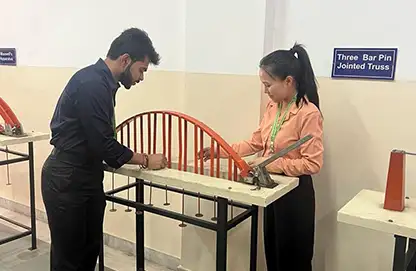
Practical experience is woven into the curriculum through fundamental laboratory courses and lab-based learning in elective courses, developing practical skills and technical aptitude.
The curriculum provides modern civil engineering software like AutoCAD, STAAD Pro, ETABS, MS Project, Primavera, and QGIS, keeping the learning of students at par with industry requirements.
An ongoing "Design Thinking and Innovation" course series from 3rd to 5th semester promotes innovative problem-solving, feasibility estimation of new concepts or start-ups, and outcome documentation in terms of research papers, patents, or products.
Project-based learning is focused with Project Phase I and Phase II in later semesters, with the goal to develop state-of-the-art research and application of engineering concepts in real-world scenarios.
Specialized courses in computing literacy and programming skillfully impart students with key digital competencies required for contemporary civil and infrastructure engineering positions.
Skill development starts right from the first semester through QAPD sessions and gets further boosted by foreign language courses in upper semesters to ensure global preparedness.
To obtain an Honours degree in B.Tech Civil Engineering with specialisation in Smart Infrastructure under lateral entry, students have to take extra credit requirements in the concerned area.
The students of the B.Tech Civil Engineering course at MRIIRS undergo internships in various semesters, namely the III, V, VII, and a prolonged internship in the VIII semester (22–24 weeks). The internships can be done in any field of civil engineering and are usually software-based internships or internships at construction sites.
Internship opportunities are planned to provide students with practical exposure in the form of industrial training, making them better prepared for actual problems. Through collaboration with esteemed industries and MoUs, students have live projects, site visits, and specialized analytical software tools for structural and site analysis made available to them. This method ensures that students are exposed to technical environments as well as field operations.
Placements for MRIIRS civil engineering students are available through various avenues. Students can be placed directly from their internship work, corporate placement drives on campus by the Corporate Resource Centre, or off-campus placement activities. Larger corporates like TCS, IBM, EY, Tata Steel, and HDFC Bank have taken up graduates, evidencing strong industry connections and placement facilitation. This multi-faceted framework assists students in attaining appropriate placements matching their capabilities and career goals.
Placement Support
Placement assistance is given through the CRC (Corporate Resource Centre) and CDC (Career Development Centre), and frequent in-campus mock interviews are conducted to enhance students' confidence and interviewing skills.
Capstone Project & Research
Students are actively involved in capstone projects and research on new areas of civil engineering including disaster management, green materials and construction methods, and the use of artificial intelligence and machine learning.
Student Support Services
A vertical and horizontal system of mentor-mentee is established, providing constant assistance for various academic and personal requirements.
Placement Statistics
The placement percentage for the 2024 batch is approximately 90%. Students have landed jobs with top recruiters—latest stats indicate the maximum salary package given was up to Rs. 32 LPA, while the median salary was Rs. 5.75 LPA. More than 500 recruiters including the giants like Accenture, IBM, TCS, HCL, Amazon, and Capgemini take part in campus recruitment. Civil engineering students always get placed with core infrastructure and consulting firms and technology-enabled positions. Complete statistics for previous years are available through the department's official placement portal.
Global Exposure
Global seminars and conferences are organised for students to participate, which helps them to get exposed to international networking and global opportunities in internships, collaborative projects, and higher studies.
Innovation & Startups
Manav Rachna Business Incubator promotes research, innovation, and entrepreneurship among students, alumni, and faculty. Access to world-class design, fabrication, and manufacturing facilities is accompanied by access to capital from a variety of sources. Mentorship, industry guidance, and networking are supplemented with regulatory, finance, and administrative assistance for entrepreneurial startups. Competency-building initiatives prepare students and nascent entrepreneurs with essential entrepreneurial and technical skills.
Alumni Network & Career Opportunities
Alumni Network
Two Alumni Sessions within a Semester
The Department organizes two alumni sessions within a semester, which provide students with the opportunity to network with and learn from successful graduates. The sessions provide current students with an opportunity to learn from the industry, gain expert advice, and establish useful professional contacts.
Future Professional Opportunities
Manav Rachna Civil Engineering alumni have future professional opportunities to varied and fulfilling careers:
Government Careers
Government career careers provide civil engineers with the opportunity to work on public infrastructure, influence major policy, and administer major codes and regulations.
Education
Academic careers provide graduates with the opportunity to develop the profession, disseminate learning, and train the next generation of civil engineers.
Consultation
Consulting careers provide practitioners with the opportunity to experiment with new ideas and work on a vast array of field projects, promoting innovative and effective engineering solutions.
Construction Industry
Civil engineers engage in the design of smart, sustainable infrastructure with emphasis on design excellence, safety, and risk management.
Research and Innovation
There are sufficient opportunities for graduates to carry out research work in areas of specialization in civil engineering for green construction and innovative technology.
Student Achievements
09 research papers have been published under “Student - Faculty” collaboration in Scopus-indexed database.
Best Practices
Development of Model based Laboratory for providing Skill / Project based Learning Introducing “Beautiful Mind” Program to encourage student’s innovation and start–ups Introduction of QC and Buddy prog to provide holistic learning approach Asynchronous learning to improve student’s engagement.
Industry Exposure
In MRIIRS, the Department of Civil Engineering provides students with extensive industry exposure by bridging studies in class with actual exposure. Industrial visits are made a regular feature every semester, wherein students are able to experience the practical utility of their class study and get direct exposure to industry professionals. Interactive field studies, expert talks, and practical internships enable intense interaction with industry and institute, exposing the students to latest trends and employment opportunities.
The department maintains good industry connections with top organizations and supports the learning process through teamwork-oriented projects, research, and practice training. Memoranda of Understanding (MoUs) with some of the major companies like UltraTech Cement, NCCBM, and Airport Authority of India provide students with practical experience on actual projects, thereby enhancing their hands-on expertise and industry preparedness. These dual programs help graduates gain the proficiency to smoothly enter into the civil engineering workforce, both academically and as a workplace familiarization.
Why Pursue ?
Civil engineering is referred to as the "Mother of all Engineering" as it is the basis of infrastructure construction and serves as a supporting base for other engineering branches.
Engineer's Day is commemorated on the birthday of Sir M. Visvesvaraya, a great civil engineer, in order to pay tribute to him for his contributions to the engineering fraternity.
Civil engineering is a developing and rapidly growing field, with immense possibilities for innovation and professional growth.
The discipline is closely in tune with the Honorable Prime Minister's Digital India Mission and Smart Cities Mission, with a thrust on sustainable urban growth and using technology for enhancing quality of life.
These factors render civil engineering a significant and futuristic choice of career.
Course Fee (Annual): INR 2,20,300 US $ 4000
Duration: 3 Years
Modes of Payment
We at Manav Rachna offer generous residential facilities and convenient transportation services so that each student, including those studying Manav Rachna, gets to enjoy a safe, comfortable, and fulfilling campus life.
MREI provides on-campus and off-campus hostel facilities for boys and girls with various types of rooms. Students can choose single, double, and triple rooms as per their preference.
Key Points
Room Types: The hostels offer different types of rooms to suit different budgets and preferences:
Fee Structure: The hostel fee is to be paid on the basis of the room category chosen by the student and it can be paid through DD (Demand Draft) or in cash.
Additional Facilities:
At Manav Rachna, we offer world-class sports facilities to keep our students fit and active. Our facilities comprise a range of outdoor and indoor games, including:
Mess plan also comes as part of hostel fee. Healthy food is served through the mess considering the multicultural requirements of different food habits for the students. By providing choices involving vegetarian as well as non-vegetarian options, healthy lifestyle is available for the students enabling them to pursue their studies focusing on programs with full seriousness.
Notable facilities include:
The facilities enable students to pursue physical exercises that complement their academic development.
Laundry facilities are available at an extra fee in the hostel fees. This saves students from worrying about laundry, so they can focus on their studies, and also allows their clothes to remain properly cleaned.
There is a vast parking space facility available for students who commute using their own means of transport. It is provided to cater to the requirements of students, so that their travel will be easy and hassle-free.
Our well-maintained transport facility offers a stress-free, secure, and safe journey for students from Delhi and Gurugram. The GPS-located, contemporary fleet of buses is operated by professionally trained personnel, with onboard support staff to assist students. Our emphasis is on reliability, safety, and convenience, ensuring unproblematic travel to and from the campus.
Manav Rachna offers a unique educational experience that combines academic excellence, practical exposure, and industry partnerships to equip students with the skills needed for real-world success.
Log in to www.manavrachna.edu.in and click on the Admissions link.
Click on "Apply Now," generate your login credentials, and fill out the form with your personal, educational, and contact information.
Fill in the application by paying online using net banking, debit/credit card, or UPI.
Get qualified through MRNAT (Manav Rachna National Aptitude Test) or produce a valid JEE Main score for merit-based admission.
Program Outcomes (PO's)
Apply the knowledge of mathematics, science, engineering fundamentals, and Engineering specialization to the solution of complex engineering problems.
Identify, formulate, research literature, and analyse engineering problems to arrive at substantiated conclusions using first principles of mathematics, natural, and engineering sciences.
Design solutions for complex engineering problems and design system components, processes to meet the specifications with consideration for the public health and safety, and the cultural, societal, and environmental considerations.
Use research-based knowledge including design of experiments, analysis and interpretation of data, and synthesis of the information to provide valid conclusions.
Create, select, and apply appropriate techniques, resources, and modern engineering and IT tools including prediction and modelling to complex engineering activities with an understanding of the limitations.
Apply reasoning informed by the contextual knowledge to assess societal, health, safety, legal and cultural issues and the consequent responsibilities relevant to the professional engineering practice.
Understand the impact of the professional engineering solutions in societal and environmental contexts, and demonstrate the knowledge of, and need for sustainable development.
Apply ethical principles and commit to professional ethics and responsibilities and norms of the engineering practice.
Function effectively as an individual, and as a member or leader in teams, and in multidisciplinary settings.
Communicate effectively with the engineering community and with society at large. Be able to comprehend and write effective reports documentation. Make effective presentations, and give and receive clear instructions.
Demonstrate knowledge and understanding of engineering and management principles and apply these to one’s own work, as a member and leader in a team. Manage projects in multidisciplinary environments.
Recognize the need for, and have the preparation and ability to engage in independent and life-long learning in the broadest context of technological change.
Program Specific Outcomes (PSO's)
An ability to identify, analyse and design civil engineering problems and use of relevant codal provisions.
An ability to pursue research, higher studies, consultancy and face competitive examinations that offers challenging and rewarding careers in civil engineering.